Introduction
Some calls feel productive in the moment but fall apart later.
A customer shares what they need, you talk through options, and the conversation ends on a positive note. Hours later, when it is time to follow up, key details are no longer clear. Pricing is fuzzy. Timing is uncertain. Next steps are assumed instead of confirmed.
This is where deals start to break down. Not because the call was missed, but because what happened during the call was not captured clearly enough to act on.
What Really Gets Missed During Live Customer Calls
Most calls feel clear while they are happening. You understand the situation, ask questions, and move toward a solution. The problem is what happens after the call ends.
Important details fade quickly when they are not captured.
What gets missed is not abstract. It is specific:
- The exact price or range discussed
- The timeline or deadline the customer mentioned
- Who is actually making the decision
- Concerns or objections raised during the conversation
- What was agreed to happen next
These are the details that determine whether a call turns into work. When they are not recorded clearly, follow-up becomes inconsistent.
Many business owners rely on memory. They assume they will remember the important parts. That works when there are one or two calls. It breaks down when there are multiple conversations in a single day.
Why This Turns Into Real Business Problems
Missing details during a call does not feel like a problem in the moment. The impact shows up later.
A quote is sent that does not match what was discussed. A timeline shifts without explanation. A follow-up email focuses on the wrong priority. A customer has to repeat information they already gave.
These issues create friction.
A customer who felt understood on the call starts to question whether the business is organized. Confidence drops. The process slows down. In many cases, the customer simply moves on to someone else who responds more clearly.
This is how opportunities are lost without any obvious failure. The call itself went well. The follow-up did not.
Over time, this pattern reduces conversion rates. The same number of calls produces fewer jobs.
Real-World Scenarios
After the Call, Details Start to Blur
A contractor finishes a call at 10:00 AM with a homeowner discussing a project. They talk through scope, price, and timing. The homeowner sounds ready to move forward.
By early afternoon, the contractor sits down to send a quote and hesitates. Was the agreed range $8,000 or $9,500? Did the customer want work done before May 15 or sometime later in the month?
The contractor either delays the quote to clarify or sends something that does not match the conversation. Both options slow down the process and reduce confidence.
A Follow-Up That Misses the Point
A service business owner speaks with a potential client who is concerned about timing. The client makes it clear that the main issue is completing the work before a specific date.
Later, the follow-up focuses on pricing and general service details. The timing concern is barely addressed.
From the business perspective, the follow-up seems complete. From the customer’s perspective, the main issue was ignored.
That disconnect is often enough for the customer to choose a different provider.
The Real Problem: No One is Working From The Same Conversation
The issue is not effort, tools, or call volume. Most businesses already use CRMs, notes, or some form of tracking.
The problem is that none of those systems show what was actually said on the call in a way that is easy to review and act on later.
After a call, information ends up spread across places like:
- short notes in a CRM
- partial details in email threads
- text messages or Slack messages
- what the owner or rep remembers
Each piece captures something, but not the full conversation.
When it is time to follow up, no one is working from a complete picture. Important details are missing, slightly off, or interpreted differently than what the customer said.
That leads to:
- follow-ups that do not match the conversation
- pricing or scope that needs to be corrected
- extra back-and-forth to clarify what was already discussed
- delays while someone tries to reconstruct the call
The result is not obvious in a single moment. It shows up as slower decisions, inconsistent follow-up, and opportunities that never fully convert.
Every Call Becomes Clear and Actionable
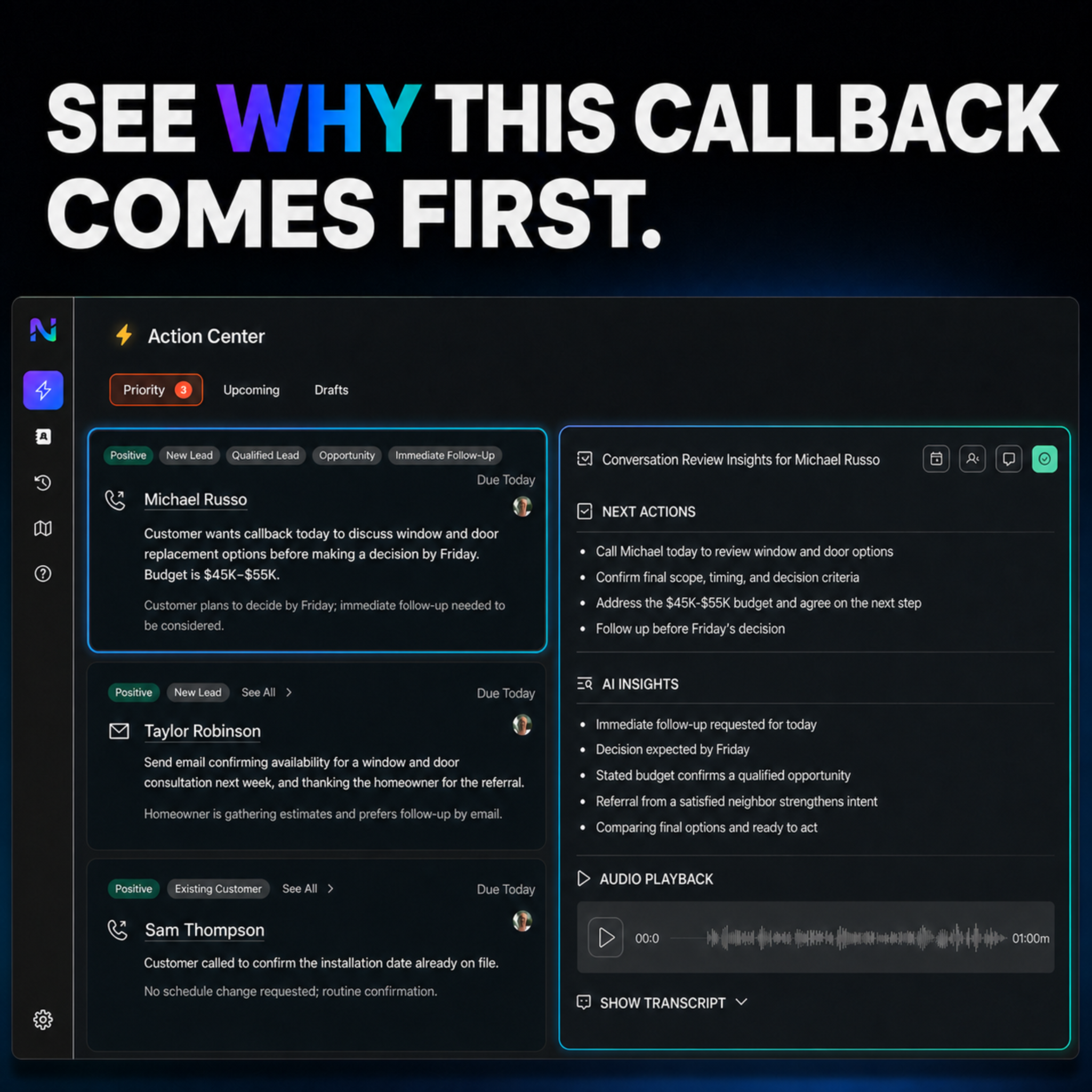
Numoloo analyzes calls and voicemails and produces a structured summary for each conversation.
After each call or voicemail, you have:
- the customer’s request
- the price or range discussed
- any timing or deadlines mentioned
- concerns raised
- the next step that was discussed
Numoloo also generates a follow-up message based on the call and surfaces the next actions from the conversation to ensure no follow up is missed.
Conclusion
The call itself is not the issue. The problem is what carries through after it.
When details from the call are incomplete or off, the follow-up starts to drift. Pricing, timing, and next steps no longer line up, and the conversation has to be rebuilt.
Numoloo keeps those details clear so the follow-up stays consistent with what was discussed.