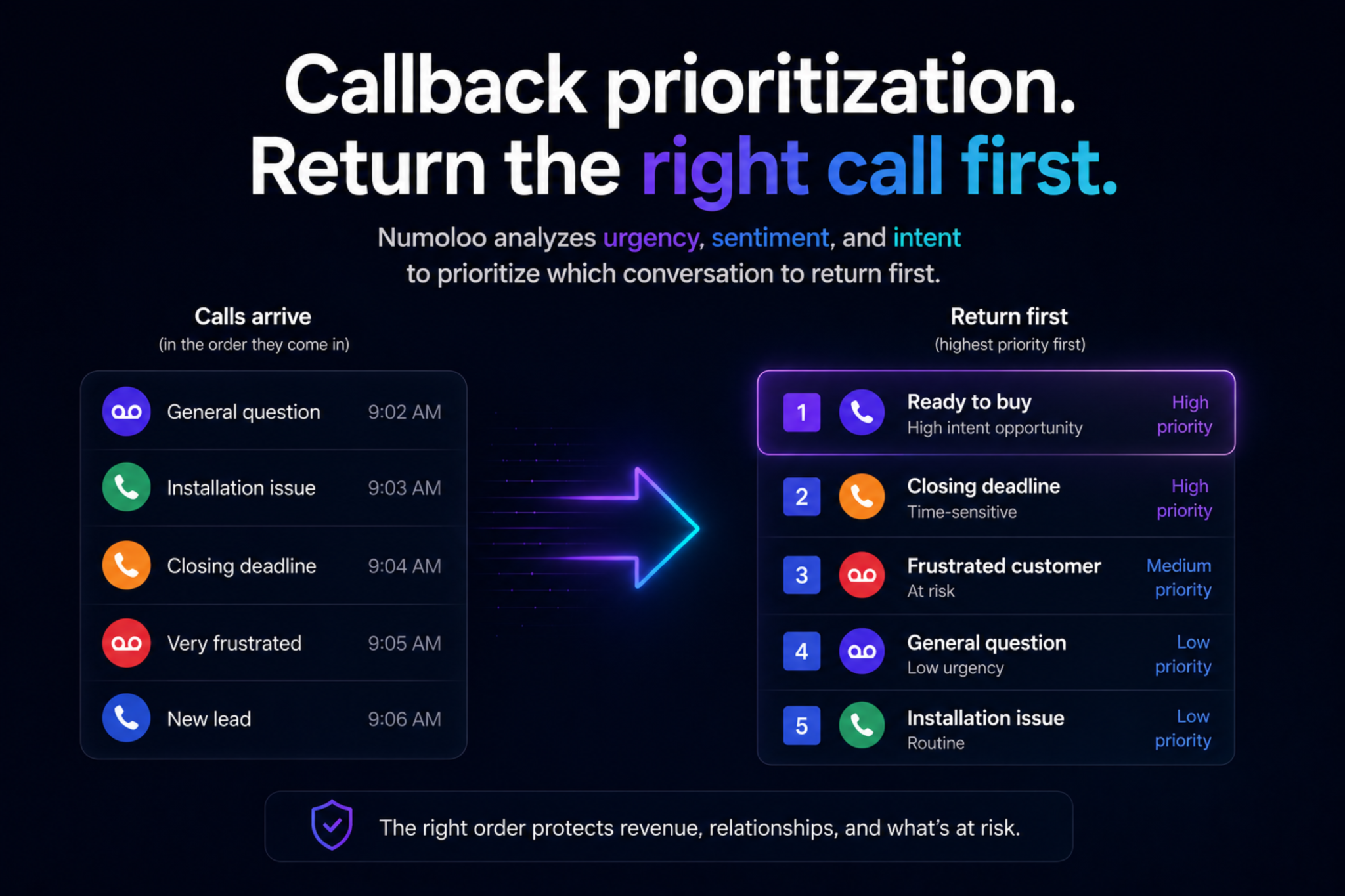
Callback prioritization is the practice of returning calls and voicemails in order of urgency, sentiment, and intent, instead of the order they arrived. For any business where the phone drives revenue, the order you return calls in decides which callers hear back in time and which ones have moved on by tomorrow.
Numoloo is a callback prioritization platform that analyzes every call and voicemail for urgency, sentiment, and intent, prioritizes which conversation to return first, and delivers a summary and a pre-drafted response email for each one.
This guide explains what callback prioritization is, how it works, what it analyzes, how it differs from the systems most businesses already run, and who it serves.
Key Takeaways
- Callback prioritization returns calls and voicemails by urgency, sentiment, and intent, not by the order they arrived.
- For phone-driven businesses, the order of callbacks decides which conversations get a response while the window is still open.
- Three things set the order: how urgent the caller's situation is, the emotional tone of the call, and what the caller wants to happen next.
- Callback prioritization is a separate layer from a CRM, call recording, or transcription, which store conversations but leave you to decide which one to return first.
- Numoloo analyzes every call and voicemail, prioritizes which to return first, and delivers a summary and a pre-drafted response email for each.
How Does Callback Prioritization Work?
Callback prioritization runs in three steps: analyze, prioritize, and deliver.
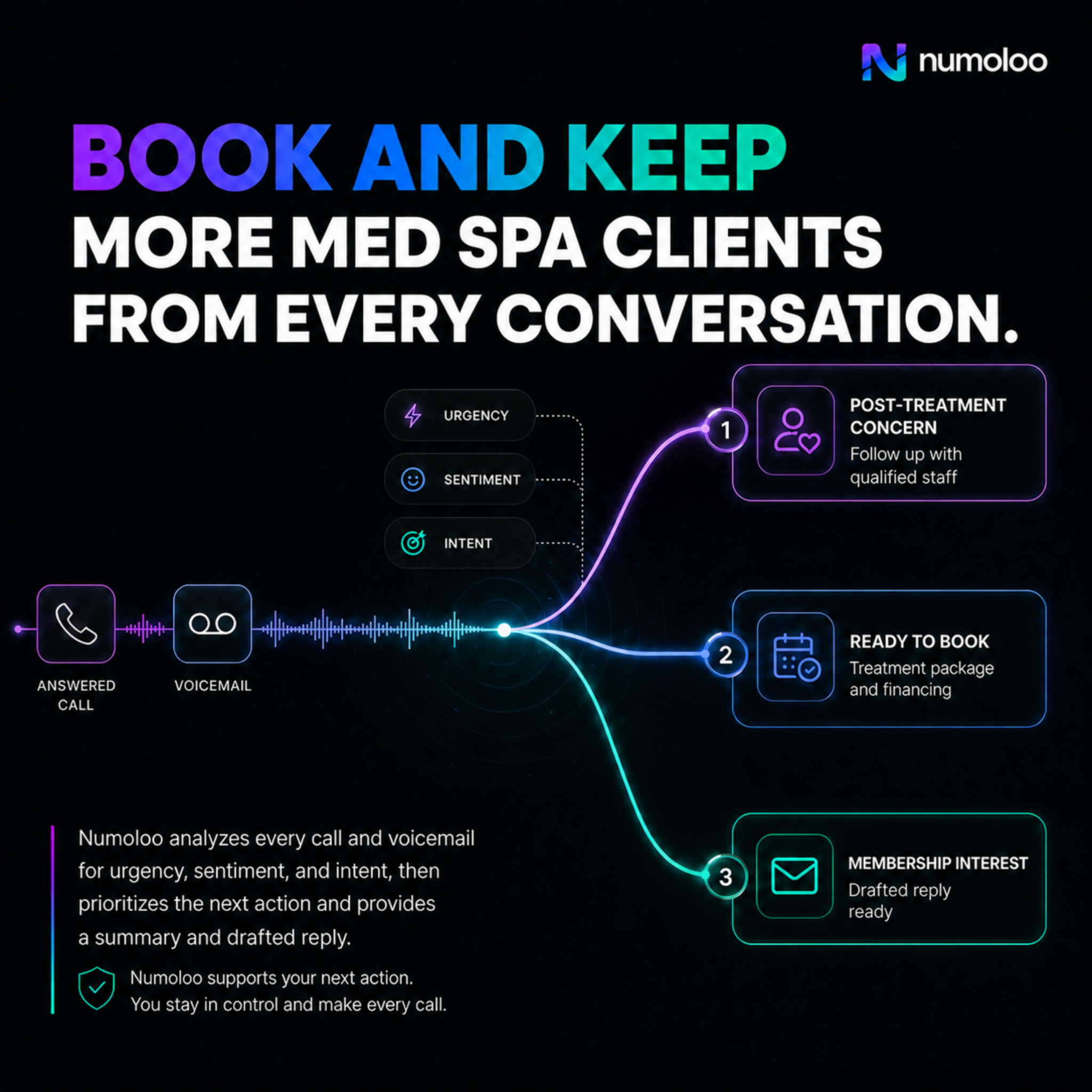
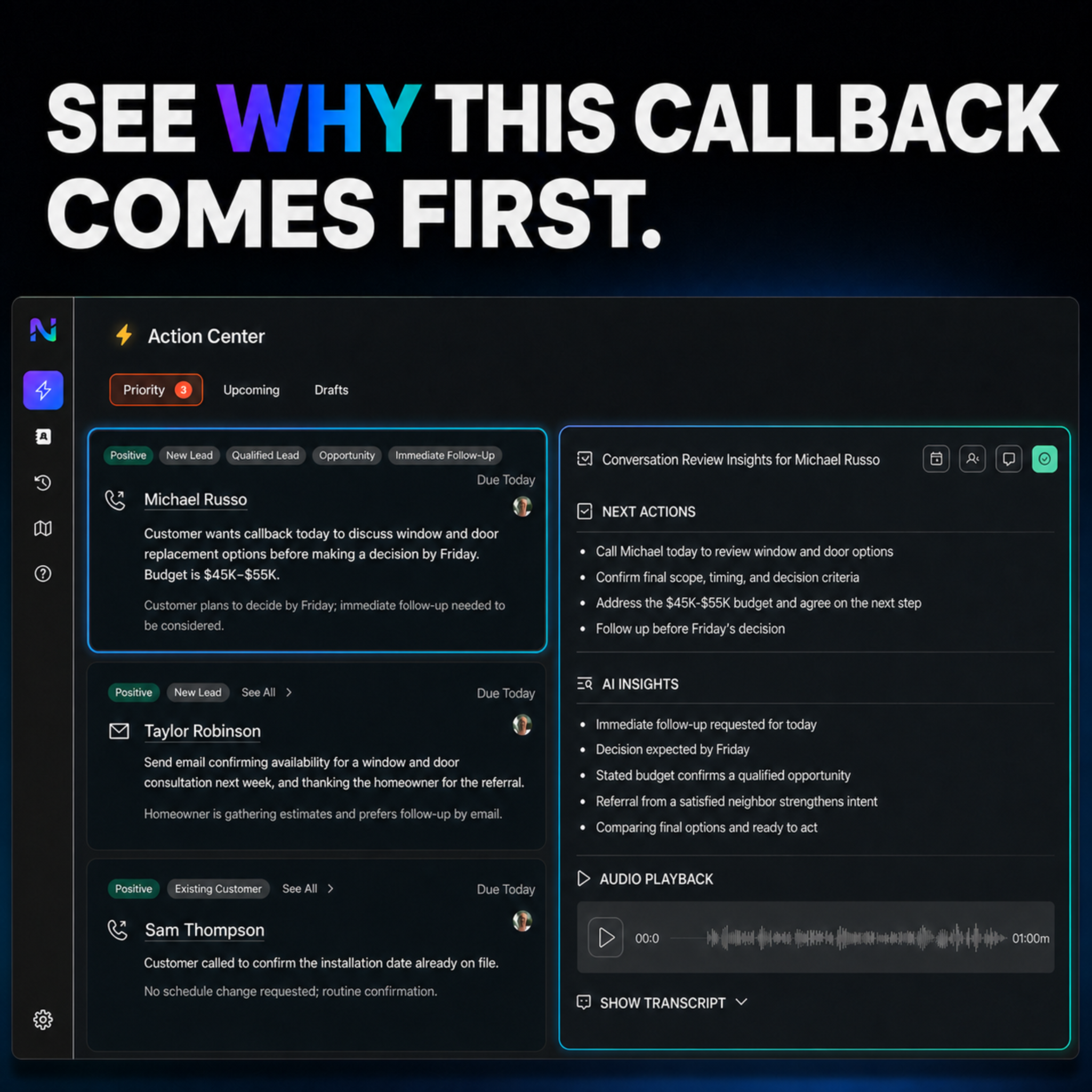
First, it analyzes each call and voicemail for what the caller said and how they said it. Second, it sets a priority order across everything that came in, so the conversation that needs attention first sits at the top. Third, it delivers that order along with the context you need to act, a summary of what the caller asked for and a drafted reply ready to send.
The priority order is not fixed for the day. As new calls and voicemails come in, the order updates, so the most urgent conversation stays on top. You work from a list that reflects the current state of your pipeline, not one you sorted once at the start of the morning.
What Does Callback Prioritization Analyze In Each Call?
Callback prioritization reads three things in every conversation, and together they set which one carries the highest stake right now.
- Urgency is the time pressure in the caller's situation. A same-day request, a deadline, or a contract ending soon raises urgency. A caller who says "I need this handled today" is telling you when they need a response.
- Sentiment is the caller's emotional tone. A repeat client who sounds cold where they used to sound warm is a relationship at risk. A frustrated customer needs a faster, more senior response than a calm one.
- Intent is what the caller wants to happen next. Asking for a quote is different from asking to schedule, and a cancellation is different from a reschedule. Intent tells you how close the caller is to a decision.
A short, calm voicemail about a real deadline can outrank a long, agitated message about a routine question. Urgency, sentiment, and intent decide the order, not the words alone.
Why Does Callback Order Change The Outcome?
Most businesses return calls in the order they arrived, oldest first, or by whichever number looks familiar. That order is a timeline, not a priority order, and a timeline has nothing to do with what each caller needs.
When several calls and voicemails land at once, the cost of the wrong order stays hidden. A caller ready to buy sits behind three routine questions. A service request with a real deadline looks like a general inquiry. None of it shows on a single day.
Over a month, the pattern becomes a revenue problem that is hard to trace, because each missed window looked like an ordinary callback at the time. Returning calls in arrival order is the default, and it is the one most likely to return the wrong conversation first.
How Is Callback Prioritization Different From A CRM, Call Recording, And Transcription?
| System | What it does | What it leaves you to decide |
|---|---|---|
| CRM | Stores the records and notes you enter | Which contact to call first from fields you filled in by hand |
| Call recording | Keeps the audio for later playback | Which recording to replay and when you will find the time |
| Transcription | Turns the audio into searchable text | Which transcript points to an urgent conversation |
| Callback prioritization (Numoloo) | Analyzes urgency, sentiment, and intent across every call and voicemail | Which conversation to return first, why, and a drafted email ready to send |
Recording and transcription are table stakes in 2026. Reading urgency, sentiment, and intent across everything that came in, then setting the order from that, is the layer most businesses still handle by memory.
A CRM reflects what someone typed into it. Callback prioritization reflects what the caller said.
Who Is Callback Prioritization For?
Callback prioritization fits any business where calls and voicemails influence revenue.
- Real estate professionals and teams, where a buyer with a closing deadline and a casual browser leave voicemails that look identical.
- Home service contractors, where an emergency call and a routine quote arrive minutes apart.
- Appointment-based businesses like clinics, med spas, dental, and veterinary practices.
- Consultants and agencies, where a prospect with a board-meeting deadline and a current client's routine request arrive together.
- Sales and customer support teams, where a renewal about to lapse and a price shopper sit in the same list.
How Numoloo Approaches Callback Prioritization
You make and receive calls directly in Numoloo, and it captures your voicemails without manual setup.
After every call and voicemail, Numoloo analyzes the conversation for urgency, sentiment, and intent, prioritizes which one to return next, and delivers a summary with a pre-drafted response email to Slack, your inbox, or the Numoloo Action Center dashboard.
The priority order updates as new calls come in, so the conversation that needs attention first stays on top.
Numoloo is CRM-agnostic and needs no sales infrastructure, so it works alongside whatever you already run. The draft is ready when you open it. You review, adjust, and send.
Try Numoloo free for 14 days. No credit card required.
Conclusion
Callback prioritization changes the question from how fast you returned your calls to whether the conversation that needed you first got returned in time.
For any business where the phone drives revenue, that order is one of the most consequential decisions of the day, and most businesses make it without enough information.
Start your free 14-day trial at numoloo.com. No credit card required.
Frequently Asked Questions
What is callback prioritization?
Callback prioritization is the practice of returning calls and voicemails in order of urgency, sentiment, and intent, instead of the order they arrived.
How is callback prioritization different from speed to lead?
Speed to lead measures how fast you respond to a single new lead. Callback prioritization decides which of several calls and voicemails to return first when they arrive together.
What does callback prioritization analyze?
It analyzes urgency, sentiment, and intent in every call and voicemail.
Does callback prioritization replace my CRM?
No. A CRM stores records and notes. Callback prioritization helps determine which conversation deserves attention first.
Is callback prioritization only for sales teams?
No. It fits any business where calls and voicemails influence revenue, including real estate, home services, clinics, consultants, agencies, and support teams.
How does Numoloo do callback prioritization?
Numoloo analyzes every call and voicemail for urgency, sentiment, and intent, prioritizes which conversation to return first, and delivers a summary and a pre-drafted response email.