A customer says, “Let me think about it.”
Most people hear a request for time.
Experienced salespeople hear something else.
Sometimes it means the customer is genuinely considering a decision. Sometimes it means they have already decided no but do not want to say it directly. Sometimes it means one concern remains unresolved. Sometimes it means they are comparing alternatives and have not told you what matters most.
The words are the same.
The meaning is not.
This is one of the biggest challenges in any business that relies on phone conversations. Customers rarely communicate exactly what they are thinking. Instead, they reveal their intent through tone, hesitation, urgency, repetition, and emotion.
The most important thing a customer tells you is often the one thing they never actually say.
Why Customers Don’t Always Say What They Mean
Most people avoid direct confrontation.
Telling a salesperson, contractor, consultant, or service provider “I’ve decided not to move forward” can feel uncomfortable. It invites questions, explanations, and sometimes pressure.
So customers soften their response.
They say:
- “Let me think about it.”
- “We’re still exploring options.”
- “Can you send me some more information?”
- “I need to run this by my partner.”
- “We’ll get back to you.”
Each statement creates space.
Sometimes that space is genuine.
Sometimes it is simply a polite exit.
The challenge is knowing which is which.
The Words Matter Less Than Most People Think
Many businesses focus heavily on what customers say.
The strongest communicators pay attention to how customers say it.
Consider two customers who both say:
“This looks great.”
One says it immediately, asks questions about timing, and wants to understand next steps.
The other says it quietly, pauses, and changes the subject.
The words match.
The intent does not.
Human communication contains layers that exist beyond language.
Voice, pacing, energy, confidence, hesitation, and emotional shifts often reveal more than the sentence itself.
The Hidden Signals Customers Give During a Call
Customers continuously reveal information about their level of interest, confidence, concern, and urgency.
The clues are often subtle.
Hesitation
A pause before answering a question often signals uncertainty.
When a customer hesitates before discussing budget, timing, implementation, or commitment, there is usually a reason.
The pause itself may be more revealing than the answer that follows.
Repetition
People repeat what matters.
If a customer asks about implementation twice, they are worried about implementation.
If they revisit pricing multiple times, price remains unresolved.
Repeated questions are rarely accidental.
They usually point directly to the concern influencing the decision.
Tone Changes
Tone often changes when a conversation reaches an important topic.
A customer’s energy may increase when discussing outcomes.
It may flatten when discussing cost.
It may become uncertain when discussing timing.
Those emotional shifts frequently reveal what the customer is weighing internally.
Urgency
Customers who are ready to act tend to speak differently than customers who are simply gathering information.
Questions about timelines, availability, onboarding, scheduling, delivery, or next steps often indicate movement toward a decision.
Intent frequently appears through urgency.
Emotional Contrast
One of the strongest signals occurs when a customer’s emotional tone does not match their words.
Someone who says, “Everything sounds good,” while sounding uncertain may be communicating something very different than the sentence suggests.
The mismatch itself is information.
Why Great Salespeople Are Exceptional Listeners
The best salespeople are rarely the people who talk the most.
They are the people who notice what others miss.
They hear the hesitation before the answer.
They notice the concern hidden inside a routine question.
They recognize when enthusiasm is genuine and when it is polite.
Most importantly, they understand that conversations happen on multiple levels simultaneously.
There is the conversation happening through words.
Then there is the conversation happening underneath the words.
That second conversation is often where decisions are actually made.
What Is Customer Intent?
Customer intent is the underlying objective, motivation, or readiness behind a conversation.
It answers questions such as:
- Is this person seriously considering a purchase?
- Are they looking for reassurance?
- Are they comparing alternatives?
- Are they trying to solve an immediate problem?
- Are they already leaning toward a decision?
Intent is not always stated directly.
In many cases, it must be inferred from the overall conversation.
That is why identifying intent has traditionally depended on experience and instinct.
What Is Customer Sentiment?
Customer sentiment reflects the emotional state behind a conversation.
Positive sentiment may indicate confidence, excitement, trust, or relief.
Negative sentiment may indicate frustration, skepticism, concern, or disappointment.
Neutral sentiment can suggest information gathering, comparison shopping, or uncertainty.
Understanding sentiment provides context for everything else happening during the conversation.
The same words can carry completely different meanings depending on the emotional state behind them.
Why Understanding Intent Matters
Businesses often lose opportunities because they respond to the words instead of the meaning.
A customer says they need more information.
The business sends more information.
The real issue was trust.
A customer says they need time.
The business waits.
The real issue was an unanswered concern.
A customer says everything looks good.
The business assumes the sale is progressing.
The real issue was hesitation.
When businesses understand intent, they can address the actual obstacle instead of the surface-level statement.
How Numoloo Helps Capture What Customers Mean
For decades, understanding intent depended almost entirely on human judgment.
Some people were naturally better at it than others.
Some conversations were memorable.
Others were forgotten.
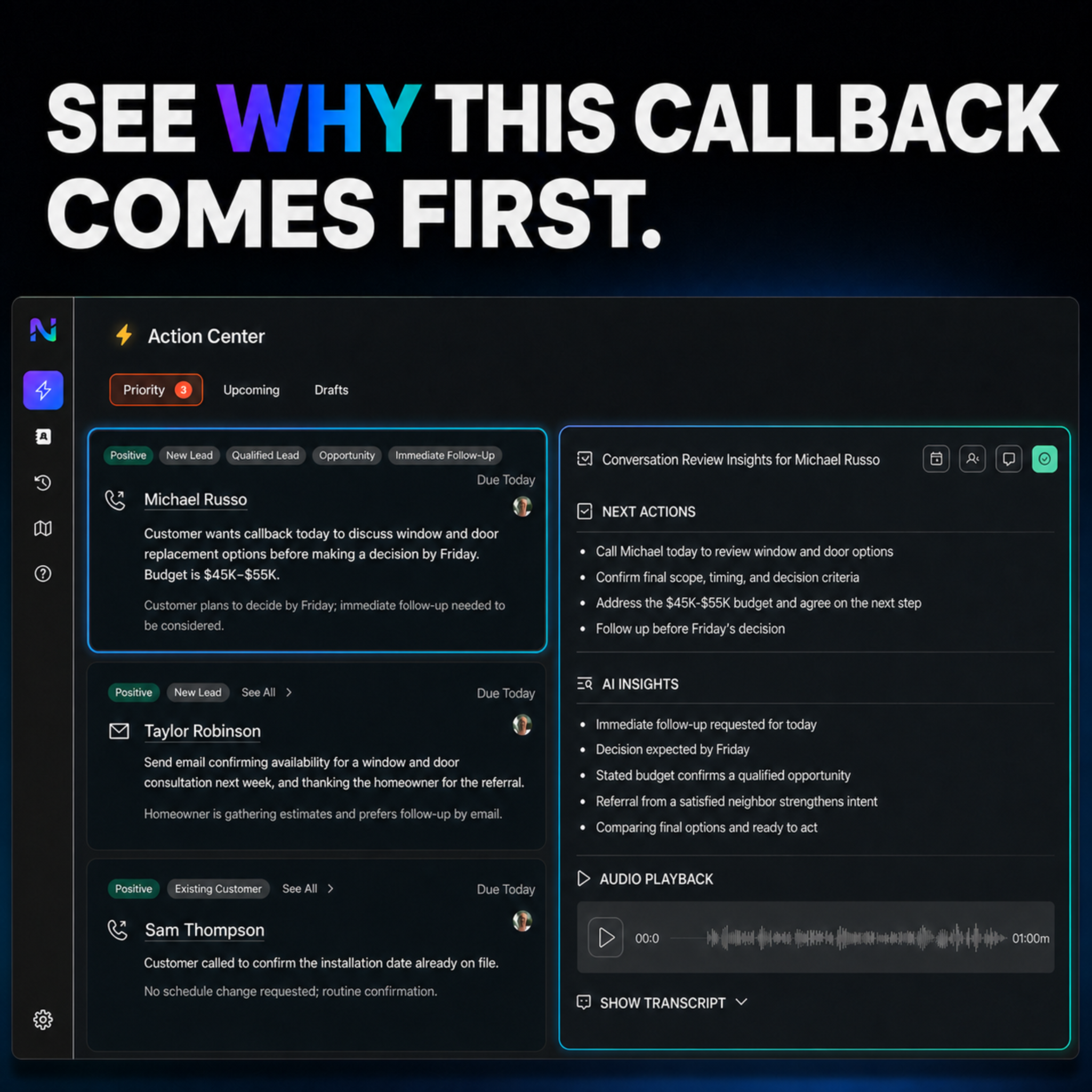
Numoloo helps make that process more consistent.
Every call and voicemail is analyzed for:
- Intent
- Sentiment
- Urgency
Instead of relying solely on memory, businesses receive insight into what happened during the conversation and what signals may have been present beneath the words.
The goal is not to replace human judgment.
The goal is to preserve the context that often disappears once the call ends.
Because what customers mean is frequently more important than what they say.
Frequently Asked Questions
What is customer intent on a phone call?
Customer intent is the underlying goal, motivation, or readiness behind a conversation, regardless of the exact words a caller uses.
How can you tell if a customer is ready to buy?
Customers who are ready to buy often ask forward-looking questions about timelines, implementation, onboarding, scheduling, or next steps. Their tone and urgency frequently support those signals.
What is customer sentiment?
Customer sentiment refers to the emotional state behind a conversation, including confidence, frustration, enthusiasm, uncertainty, trust, or concern.
Why do customers say “let me think about it”?
Sometimes they genuinely need time. Other times they are expressing hesitation, uncertainty, or a decision they are not comfortable stating directly. Context, tone, and surrounding conversation cues help determine the difference.
Can software detect customer intent and sentiment?
Yes. Modern conversation analysis platforms can identify patterns related to intent, sentiment, urgency, and emotional signals within calls and voicemails.
The Conversation Beneath the Conversation
Customers do not always communicate their intentions directly.
Sometimes they reveal them through hesitation. Sometimes through urgency. Sometimes through a question they ask twice or a shift in tone when an important topic comes up.
Experienced salespeople learn to recognize these signals. They listen for what customers mean, not just what they say.
Because the most important part of a conversation is often the part that was never spoken aloud.
That is why understanding urgency, sentiment, and intent matters. The words tell part of the story. The signals behind them often tell the rest.